
Welcome to
the Forum
Engage innovators and practioners on the edge of technology advancement.

.webp)
Why Quantum Computing's Future Belongs to the Fab Floor
Forty years after a graduate student set out to test whether currents and voltages in a hand-built circuit could obey the rules of quantum mechanics, that same researcher now holds a Nobel Prize and runs a startup focused on a less romantic problem: manufacturing quantum computers at scale. My recent conversation in Santa Barbara with 2025 Nobel laureate John Martinis, co-founder of Qolab, and ZeroPoint’s Nilesh Shah made it clear that quantum’s next revolution will be built in fabs and data centers. My co-host for this Data Insights episode was Solidigm’s Jeniece Wnorowski.
From a 1980s Thesis to a Nobel Prize
John’s Nobel Prize traces back to a graduate-school question. As a thesis student in the early-to-mid 1980s, working alongside his co-winners John Clarke and postdoc Michel Devoret, he set out to test something foundational: whether a macroscopic variable, say currents and voltages in a circuit, could obey the laws of quantum mechanics. They did. The applied vision came much later.
“It's natural to think about building an electrical quantum computer, because the computers that we use today are based on electrical circuits,” said John.
What Quantum Supremacy Really Means
In 2019, John’s team at Google published results from the Sycamore quantum processor, completing in 200 seconds a calculation estimated to require 10,000 years on classical hardware. Better classical algorithms have closed some of that gap, but the underlying argument holds.
“Some people don’t like the word supremacy, and want to say quantum advantage,” he said. “But I’ve always said supremacy because of this fact. It’s not just a little bit better, but it’s kind of exponentially better in that as you make the systems bigger, it just becomes hopeless to try to simulate that with a regular computer.”
From Golden Chandelier to Integrated Circuit
If 2019 settled the science, the next phase is harder. Today’s quantum machines are still hand-built lab instruments.
“If you look at the quantum computers now, I call it the golden chandelier,” John said, beautiful in their tangle of microwave components and wiring, but not mass producible.
He sees a clear historical analogue. The plan is to do for quantum what semiconductor manufacturing did for classical computers in the 1950s and 60s: trade the mess of wires for the integrated circuit. To get there, Qolab is working with semiconductor partners on better fab processes and chip-scale packaging. A million-qubit machine built with current techniques would run into the tens of billions of dollars. His bet is that fab-scale manufacturing will bring the cost down the same way it did for chips.
Where Quantum Meets the AI Data Center
Nilesh pulled the conversation back to today’s AI build-out, where hyperscaler economics are denominated in power. As data center usage is increasingly measured in gigawatts, energy becomes the finite variable. In this scenario, quantum has to earn its place in three ways: improving power efficiency, cutting latency, or unlocking stranded data center capacity in legacy infrastructure.
Nilesh also flipped the dependency most people assume: today, classical infrastructure carries quantum, not the other way around.
“Today it’s actually quantum computing that is leveraging the power of AI and GPUs and CPUs to make these quantum computing elements more stable,” he said, pointing to real-time error correction, system-level calibration, and the digital twins that researchers run alongside live quantum experiments.
One hyperscaler’s multi-million-dollar quantum rentals last year drove a much larger demand for classical compute, in terms of storage, memory and processors needed to feed quantum applications.
When the Inflection Arrives
Asked when quantum’s ChatGPT-style moment might arrive, John didn’t hedge.
“The standard quote I give is 5 to 10 years,” he said, “with the caveat that people are being very optimistic about the system engineering challenges. We have a little bit of time, but you have to start working on it right now.”
Nilesh framed the wait through the lens of risk.
“The question that people are asking is not should I invest in it, but rather, can we afford not to invest?” He layered in the geopolitical reality, noting that quantum has become a national mandate well beyond the U.S., with sovereign investment accelerating across Europe, Canada, China, and Australia.
Advice for the Next Generation
When I asked what students considering scientific careers should focus on, John leaned into his role as an educator at UC Santa Barbara. The physics courses are still essential, but engineering courses are just as important: programming, microwaves, optics, and packaging are all core to building real systems, and the field rewards range. He pointed to a former Google colleague who came in with a software background, learned quantum on his own, and “started breaking these limits that everyone put because they made wrong assumptions on it.”
Nilesh, whose own first quantum experiments came through Intel’s open-source qHIPSTER simulator and an early five-qubit IBM machine, agreed.
“It is a multi-disciplinary type of a field,” he said, urging the industry to do a better job of communicating quantum’s career opportunities to students who today gravitate toward machine learning and large language models.
The TechArena Take
Quantum computing’s first revolution was scientific. Its next, as this conversation made clear, will be built in fabs and data centers. The question is no longer whether the physics works, but rather whether the supply chain and economics can keep pace with what science has proven possible.
For data center leaders, quantum is already pulling demand for classical infrastructure, and preparing for the inflection point, be it across cryptography, materials science, drug discovery, or AI-adjacent workloads, is no longer optional. The timeline may be uncertain, but not the need to start.
Listen to the full Data Insights episode on TechArena.ai.

Inside a High-Stakes Infrastructure Overhaul
Rakesh Awasthi explains how his company uses AI to decode legacy systems, recover lost knowledge, and modernize mission-critical data infrastructure.
Foresight Works Tackles the Execution Gap in AI Buildouts
The race to build AI infrastructure is defined, in most coverage, by megawatts announced, leases signed, and capital deployed. What gets less attention is whether any of it actually gets built on time. Atif Ansar, co-founder of Foresight Works, has spent 15 years studying why large projects fail, including through academic work at Oxford University. In my recent conversation with him and Solidigm’s Jeniece Wnorowski, Atif shared an insight from that work that shapes his company’s direction: the limiting factor in the AI data center boom is not technological, but human.
Foresight Works offers a project delivery platform combining AI, proprietary data, and scheduling methodologies developed through Atif’s academic research. The platform is built around the idea that projects are human systems, and that basic psychological biases that can harm outcomes can be overcome with processes that ensure both micro daily commitments and larger goals are met.
The Real Bubble Risk
In discussion about a potential AI infrastructure bubble, the concern usually voiced is about overbuilding. Will the supply of new data center capacity outpace demand? Atif rejects that framing. He points to accelerating demand for AI-enabled services and the contractual structure of hyperscaler leases as evidence that demand is not the problem. The problem, he argues, is delivery.
“These data centers are being built under contract from very high rated companies like hyperscalers,” he explained. “And as a result, they have 15-year leases. So the developers are not taking huge amount of risk.” But that contractual protection cuts both ways. A single month of delay on a 100-megawatt facility can cost $15 million or more in lost early revenue, and service level agreement penalties from hyperscalers compound the damage further. Atif estimates that more than a three-month delay can dissipate the net present value of even a very large build. “The penalties for missing your targets become potentially insolvency causing for companies that are not well managed,” he said.
The Watermelon Problem
One of the more memorable concepts Atif brought to this conversation was what he called the watermelon problem, a phrase for projects that are “green from the outside until they suddenly turn red.” Atif noted that the gap between perceived and actual progress is typically a product of optimism bias and political pressure, not malice. Teams hope they will catch up. But often, they do not.
The interdependencies inside a data center build make this particularly dangerous. A purchase order that should have been issued today, but was not, means a missing piece of equipment six months from now. The delay is invisible until the moment it becomes a crisis. “What lets people down is the accumulation of these very small variances,” he noted. “It’s actually those micro details that make the difference.”
Foresight is designed to function as a control tower, allowing organizations to manage the macro picture while having a handle on micro variances early enough to act on them. In one case, the platform uncovered a five-month delay buried beneath distorted reporting.
Where Schedules Break Down
Atif has identified recurring patterns in how project schedules fail. One is an overemphasis on civil and structural work, which is visually dramatic and easy to represent, at the expense of mechanical, electrical, and plumbing work, which is complex and harder to schedule. “Nearly 60 to 80% of a data center is MEP,” he noted. Treating it in broad strokes rather than mapping it with precision is a reliable path to delay. A second pattern involves compressing commissioning into the final phase of a build, when factory and site acceptance tests should begin far earlier, alongside procurement and equipment delivery.
Foresight’s AI layer helps identify structural gaps in submitted schedules, particularly missing milestones or poorly sequenced dependencies. “We help them look at what milestones they are likely missing or what gates they’re likely missing and help them insert those back in the appropriate places,” Atif said.
A Skills Supply Crisis Beneath the Capital Crisis
The execution problem extends well beyond data centers. Digital infrastructure, the energy transition, and defense spending are all generating enormous project delivery demands simultaneously on top of existing demand from evergreen sectors like pharmaceuticals and civil infrastructure, and the construction workforce is not keeping pace. Atif estimates that data centers represent roughly 10% of the global construction market by value, yet the people working in the industry amount to just 0.05% of the global construction labor force.
“So it’s still a cottage industry in terms of the footprint,” he said. “They need a lot of technology, automation, and AI to simply keep pace. They also need education…and I think that we need to upskill people and train them in the art of becoming better project managers.”
The TechArena Take
While day-to-day execution doesn’t typically garner headlines, Atif's work makes a compelling case that it deserves far more attention from executives committing capital to AI infrastructure. The trillion-dollar build underway globally requires disciplined upfront planning, clear governance, and repeatable processes. The developers who get this right are those who invest in process maturity early, building the kind of credibility that holds up with communities, investors, and hyperscalers alike. Platforms like Foresight Works represent an important step toward making that discipline accessible at scale, at a moment when the cost of getting it wrong compounds with every month of delay.
To learn more, listen to the full podcast or visit foresight.works.
Submer Group: Data Centers Must Build for the Long Term
Sustainability, when it even enters the conversation for data centers today, means different things to different people. It is a broad topic, including energy use, water use, e-waste, and the effects of rapid growth. Gabriel Lazar, head of sustainability at Submer, a Barcelona-based full-stack data center company, sees a need for both greater specificity and more comprehensive systems thinking as part of organizational strategies.
In a recent discussion with Gabriel and Solidigm’s Ace Stryker, Gabriel laid out a pragmatic framework for thinking about data center impact: one that spans energy, community relationships, and the uncomfortable question of whether the industry is using what it builds.
The Cost of Growth Without Durability
The data center industry is struggling with sustainability, and Gabriel is direct about it. About half of data center operators don’t even have sustainability plans in place. Many companies that do have them are still moving in the wrong direction. Part of the difficulty is the recent push for higher performance and scale hasn’t considered what will make what is being built now durable for years to come.
What the industry needs, Gabriel argued, is a genuine reduction in resource intensity, pursued with enough specificity to actually be achieved. He expressed optimism that data centers and digital infrastructure can continue to have a smaller environmental footprint than heavy industries like steel making or car manufacturing. . Getting there requires separating growth from impact, finding ways to scale the industry while bending the resource curve downward. “We need to start seeing that graph divide, with impact going down and the growth going up.”
Thinking in Systems, Not Silos
One reason sustainability conversations fall short, Gabriel argued, is that they tend to stay within the boundaries of the sustainability field itself. The forces shaping data center infrastructure today, including geopolitical risk, supply chain scarcity, energy market structures, and community relations, do not respect those boundaries. Addressing them requires a multi-disciplinary approach that borrows from fields with more practice at managing complexity.
“If we were to pick a field that is best at doing this right now, it’s probably risk, and more specifically, if you look at insurance companies, they’re amazing at capturing this because they have so much data and they’re able to crunch it,” he said. Having people from different backgrounds collaborating and communicating is the best path to addressing the extremely complex, interconnected challenges such as power shortages that the industry is facing today.
Heat Reuse: Valuable, but Not Universal
Gabriel leads a heat reuse workstream for the Open Compute Project, so his cautious take on the topic may come as a surprise. The logic of heat reuse is straightforward: nearly all the energy flowing into a data center converts to heat, and using that heat for other purposes rather than dissipating it is sensible in principle. In practice, though, the economics depend heavily on geography and local infrastructure.
District heating networks, common in Germany and other northern European countries, make heat reuse viable at scale. In Spain, where Submer is headquartered, or in the United States, those networks largely do not exist. Trying to mandate heat reuse uniformly across markets will produce uneven and often poor results.
“It might just be 20% of data centers worldwide that are applicable,” Gabriel said. “I think that makes more sense than trying to hit it all and not getting anything.”
He flagged desalination and water treatment as underexamined applications for heat reuse, noting their round-the-clock demand profile. The constraint, again, is proximity: only data centers sited near coastlines or water treatment facilities would benefit. The pattern across all of these examples is the same: broad ambitions need to be matched with specific, locally grounded analysis before they translate into real outcomes.
The Community Dimension
Beyond grid dynamics and thermodynamics, Gabriel emphasized that sustainable infrastructure is also a social proposition, and one that requires the same place-specific thinking. Heat reuse, for all its complexity, offers something rare in the industry: a tangible benefit that local communities can see and understand. Unlike grid flexibility programs or ancillary services markets, a data center supplying heat to a nearby manufacturer or supporting a local business is a concrete value proposition to the people who live nearby.
That matters for the permitting process. “It goes a long way for that regulatory process, the buy-in, the social license to operate,” Gabriel said. Operators who engage communities early, rather than as an afterthought or not at all, tend to move faster through approval and run into fewer delays. This practice also helps with future projects as a reputation builder. The TechArena Take
Gabriel’s argument is ultimately a call for better engineering of the sustainability problem itself. Sustainability as a vague aspiration produces vague results, if any. Sustainability as a set of specific, locally calibrated initiatives focused on relevant topics can produce real outcomes. Infrastructure should not be considered in isolation, especially not when it plays such a crucial role for societies. In the race to build data centers, systems and longer-term thinking should be key. To learn more about Submer’s work, watch our full podcast or visit submer.com.
MiTAC Computing Bets the Future on Turnkey AI Infrastructure
As general manager of MiTAC Computing, Raymond Huang is building the case that validated, pre-integrated infrastructure is the best path to AI at scale. His company, long known as a manufacturer of high-performance compute systems, has evolved into a provider of end-to-end AI infrastructure solutions. In a recent TechArena Data Insights episode, Solidigm’s Jeniece Wnorowski and I talked to Raymond about the strategy, the partnerships, and the technical decisions driving that evolution.
The Evolution to Delivering Turnkey AI Capacity
MiTAC’s transformation has been driven by three converging pressures: the technical demands of modern AI workloads, economic pressure on margins and differentiation, and a customer base that increasingly wants faster time to deployment. In response, the company is developing turnkey AI infrastructure solutions built around pre-integrated rack-level systems in which servers, GPUs, networking, power distribution, and cooling are validated together before they ever reach a customer site.
“The AI factory is a new category we're working on,” Raymond said. “MiTAC is aligned around the modular AI cluster as a building block. We don’t just build servers; we deliver AI capacity.”
That positioning matters because the traditional model, in which customers sourced components separately and spent months integrating them, is increasingly untenable at the pace AI demands. Raymond noted that MiTAC’s approach compresses that timeline significantly, moving customers from months of integration to days or weeks of installation.
Solving the Density, Power, and Cooling Equation
AI clusters are constrained by how tightly GPUs can be packed without hitting thermal or power ceilings. MiTAC addresses this through pre-designed high-density rack configurations validated for specific GPU setups, ranging from 32 air-cooled GPUs per rack to 96 GPUs per rack with liquid cooling. This eliminates the trial-and-error phase that often accompanies high-density deployments.
Power delivery is equally central to the approach. Modern GPU racks can draw easily from 30 kilowatts up to 130 kilowatts, and instability in that power supply creates downstream problems that are expensive to diagnose and fix. Because MiTAC controls both the design and manufacturing of its systems, it can pre-match power profiles to specific GPU and CPU configurations from the ground up. That end-to-end ownership allows the company to engineer across voltage options including 208V, 415V, 480V, and potentially the upcoming 800V DC standard.
On cooling, the company has developed direct liquid cooling systems capable of removing up to 95 percent of generated heat via a liquid loop. Raymond pointed to MiTAC’s G4826Z5, a 4U system built around dual AMD EPYC 9005 CPUs and AMD Instinct MI355X GPUs, as a demonstration of what liquid cooling makes possible.
“Without the DLC, this kind of density wouldn’t even be thermally practical,” Raymond said. “The system isn’t performance throttling even during long AI training runs. So the system sustains peak GPU utilization instead of cycling down due to heat. This is critical to the large language model training or HPC simulation multi-AI workload jobs.”
A Partner Ecosystem Built Around the Full Stack
In our Data Insights series, we often discuss how as AI infrastructure becomes more data intensive, application performance relies on compute and storage working together optimally. Raymond described a set of partnerships that MiTAC has developed to address the layers of the AI stack to enable high performance. For example, with Solidigm and DDN, MiTAC has built a storage solution pairing its servers with Solidigm NVMe drives and DDN software to eliminate the I/O bottlenecks that can leave expensive GPU clusters sitting idle waiting for data.
For orchestration, MiTAC has partnered with Rafay, whose managed Kubernetes platform and GPU orchestration tools simplify cluster management across multi-node environments. The combination allows customers to go from power-on to a usable cluster significantly faster, with centralized policy management that scales consistently from a single rack to 500.
Another collaboration reflects MiTAC’s commitment to reducing the energy footprint of AI infrastructure: its work with Akash Systems using diamond-based cooling. Because diamond conducts heat at roughly five times the rate of copper, the resulting systems consistently run up to 10 degrees Celsius cooler than standard configurations, delivering measurably better performance per watt without increasing energy consumption.
Manufacturing Localization and the Road Ahead
MiTAC is also expanding its North American manufacturing footprint to meet demand for localized supply chains. Raymond described the company’s capacity as several thousand racks per month, with a focus on building, fulfilling, and supporting AI infrastructure locally in each region it serves.
Looking a few years out, Raymond sees data center design converging around liquid cooling as the universal standard, rack densities climbing toward 100 kilowatts to potentially one megawatt per rack, and hybrid on-site power generation becoming common. The organizing principle Raymond returned to is modular, repeatable architecture.
“Think of it like Lego blocks for AI capacity,” he said. “This is extremely critical for deploy to speed needs.”
The TechArena Take
MiTAC’s evolution to an AI infrastructure provider reflects a broader maturation in how the market thinks about deploying AI at scale. Validated, pre-integrated solutions that compress deployment timelines and reduce operational risk are becoming increasingly crucial. Raymond’s message to technology decision makers is straightforward: the competitive question is how quickly and reliably you can put your chosen infrastructure to work. MiTAC understands that customers who face that pressure will value solutions that arrive ready to run.
For more information, listen to the full podcast episode, or visit MiTACcomputing.com.

The Next AI Moat Is Workforce Adaptability
Bots. Apps. Agents. Copilots. More “game-changing” demos than anyone can reasonably process. And yet, I still hear the same thing from enterprise leaders:
“Our teams are still moving too slowly.”
This is the thing AI has not magically fixed.The next advantage will not come from generating more content or deploying yet another chatbot. It will come from turning knowledge into behavior faster than your competition.
I am convinced the real advantage will not come from who adopts the most tools first: It will come from how quickly an organization can help its people continuously adapt through behavioral change.
That is the part of the AI conversation that is underdeveloped. We must talk about the human operating system inside the enterprise: how people learn, how behavior changes, how managers reinforce new ways of working, and what it takes for knowledge to become execution.
The Enterprise Already Has More Knowledge Than It Can Use
Most large companies are buried in expertise and data. Product decks, training portals, internal wikis, meeting notes, pivot tables of data and tribal knowledge all pile up across the organization. The issue is not whether knowledge exists, it’s whether it reaches the right person, with the right context, at the right moment, in a way that is useful to them.
I saw this firsthand in large-scale enterprise environments. Teams would spend months preparing for a product launch. Leaders would travel globally while sales teams would attend multiple trainings. Content would be published and everyone would check the box. Then months later, in front of a real customer, at a critical moment, the knowledge often was not there when it mattered, resulting in a missed opportunity.
AI Has Made the Learning Problem Harder, Not Easier
AI increases the rate of change and pressure, with products and positioning evolving faster and customer expectations and needs changing even more rapidly. Enterprises are being asked to absorb an insane amount of information and apply it with less time, creating friction inside organizations and channels.
The issue becomes whether sellers can apply the right knowledge at the right moment in a month-long sales cycle. The AI skills gap is both a skills and adaptability gap, and it may be the biggest execution risk most companies are underestimating.
Behavior Change is the New Moat
Can your organization turn its knowledge into changed behavior?
Can your partner ecosystem stay aligned when products, positioning, and market conditions change overnight?
This is where enterprise learning has to evolve to become an adaptive system built with humans in the loop, that understands role, context, timing, readiness, and application. Access to information is not the same as readiness. A chatbot can retrieve an answer. It does not automatically build judgment, fluency, confidence, or accountability. More importantly, it does not guarantee that a team changes how it sells to, supports or serves customers.
The real challenge is helping people perform better in moments that matter, with useful, AI-powered solutions. That is why the next moat will be workforce adaptability. The winners will be the ones that convert knowledge into changed behavior before their competitors even finish rolling out the next tool.

For Infleqtion, Quantum’s Moment Is Closer Than You Think
Quantum computing is a transformative technology that is consistently positioned not as a replacement to classical computing, but as complement. As the technology moves out of the lab, the pressing question for technology decision makers is becoming how soon that addition will become relevant to infrastructure build-outs. Solidigm’s Jeniece Wnorowski and I recently sat down with Pranav Gokhale, CTO and co-founder of Infleqtion, for a conversation that explored where quantum fits in the modern compute stack, where it is already delivering value, and what the next few years are likely to bring.
Not a Replacement, a Co-Processor
Pranav started our conversation by exploring the interconnected relationship between quantum and classical computing. Infleqtion sees a future of hybrid quantum-classical computing systems, and supporting evidence for that is already visible in the efforts of the industry’s biggest players.
“GPU has not replaced CPU. It’s been a co-processor,” he explained. “In the same way, we think that CPU and GPU are going to be co-processors to QPUs, or quantum processing units.”
Industry leaders are in agreement. At NVIDIA’s GTC conference, in fact, Infleqtion’s quantum machine was featured at the NVIDIA booth, connected to graphics processing units via NVQLink. The vision is a hybrid compute fabric where software orchestrates workloads across all three processor types, routing the most computationally demanding problems to the QPU while CPU and GPU handle the rest.
Real-World Value, Available Now
Building on this concrete example, Pranav was direct about where quantum-derived value is already being delivered, and the industries span defense, genomics, and materials science.
Infleqtion has deployed quantum-inspired machine learning models to NVIDIA Jetson edge GPUs, and the US Navy and US Army are among its customers. One application is sensor data fusion in environments where GPS signals are being disrupted. That means those in unfamiliar territory could rely on edge-deployed systems that use computer vision or even celestial navigation to maintain positioning.
The genomics application is equally striking. The human genome contains 6 billion base pairs, roughly 6,000 times longer than what current large language models can process in a single context window. Scaling up classical compute does not solve the problem efficiently. “Every time you double the context window, you have to 4X the GPU,” Pranav explained. Infleqtion’s quantum-inspired contextual machine learning model last year set a new record on genomic sequence processing by treating memory constraints differently than classical approaches.
Finally, a joint publication with NVIDIA, released approximately five months before our conversation, demonstrated quantum-GPU co-processing applied to materials science. The target application: understanding how electrons interact inside battery chemistry, a problem with significant commercial implications for improved battery performance and life if it can be solved at scale.
AI and Quantum: A Mutual Dependency
While AI and quantum computing are often discussed as separate tracks, Pranav made clear they are increasingly interdependent.
AI, specifically GPU-accelerated inference, is central to quantum error correction. As a quantum computer runs, it accumulates errors from environmental noise. GPUs can analyze that output, identify where errors occurred, and correct them, much the same way that wireless protocols clean up noise to deliver a clear signal to your phone. “We’re taking noisy quantum bits, qubits, and turning them into a very pristine signal using AI to detect where did something potentially go wrong,” Pranav said.
This is precisely why NVIDIA’s investment in quantum adjacency is deepening. Their GPUs are not just powerful compute resources for classical workloads; they are a critical component of making fault-tolerant quantum computing viable on a faster timeline.
The 2028 Horizon
Infleqtion’s internal roadmap targets 2028 as the year the company expects to reach 100 reliable, fault-tolerant logical qubits. At that threshold, Pranav believes quantum systems will begin outperforming the world’s largest supercomputers on specific, high-value problem classes: materials discovery, drug design, chemistry simulation, and certain AI workloads.
“Every time we make a little bit of progress, it doubles and quadruples and 10Xs the performance of the quantum computer,” he said, describing the non-linear scaling dynamics that distinguish quantum from incremental classical improvements.
The TechArena Take
Quantum computing has spent years as a technology of perpetual promise. What the conversation with Pranav reflects is a field that is transitioning from research curiosity to engineering roadmap. The hybrid CPU-GPU-QPU stack is already being demonstrated. So while quantum purchasing decisions are not quite imminent, the infrastructure decisions made over the next two to three years should account for a compute landscape that soon is likely to look meaningfully different.
Learn more about Infleqtion and its quantum computing and sensing technologies by watching our full podcast or visiting infleqtion.com.

Scaleway Makes the Case for a Cloud Strategy Built on Control
There’s a long-held idea in enterprise technology that people who make safe, conventional procurement decisions stay employed. Today, that logic is playing out as procurement teams and IT leaders choose dominant global cloud platforms not because they’ve done a thorough evaluation, but because it feels like the default.
Solidigm’s Ace Stryker and I recently sat down with Albane Bruyas, chief operating officer of Scaleway, who made a compelling case that the “safe” choice may come with unexpected risks, and that having a backup plan is critical. With 25 years of cloud experience behind it, Scaleway is working to demonstrate that a homegrown European complement to the global hyperscalers is essential for organizations that care about control, cost transparency, and long-term resilience.
More Than Sovereign: The Case for Full-Stack Control
Scaleway describes itself as both a sovereign European cloud provider and a neocloud built for AI infrastructure. For Albane, however, the word “sovereign” only gets you so far.
“What is very interesting for our clients is that we sell full autonomy,” she said. “We have control on all the value chain. This is what makes the pure difference for our clients.”
That control extends across software, hardware, network transit, and pricing. Scaleway operates within a major French telecommunications conglomerate, which gives the company ownership over connectivity that most cloud providers must outsource. The result, Albane argues, is a level of transparency and pricing stability that organizations cannot get from vendors who depend on third-party components throughout their stack.
Sustainability is also woven into this argument. Because Scaleway built its data centers, primarily in France, it has been able to optimize for energy efficiency. That includes tracking and reducing carbon footprint at the hardware level, a capability made more precise by the company’s participation in the Open Compute Project.
A Procurement Argument Rooted in Risk
Before joining Scaleway, Bruyas worked in industrial procurement, and she brings that lens directly to conversations with enterprise buyers. In industry, she notes, you always ensure you have at least two suppliers for physical goods. Her message is straightforward: operating differently with your digital suppliers doesn’t eliminate risk. It invites it.
“In the digital world, people are just forgetting that their principal strategic supplier is a unique supplier they cannot move out from,” she said. “There is no solution if there is a crash. There is no solution if different prices come out. No solution if there is an external government that asks for data. You have no choice.”
Her advice to organizations anchored to a single hyperscaler is practical, not confrontational: “You will never be fired because you choose one of the scalers. So it’s just like, test an alternative. You need to have one, and you will be happily surprised,” she said.
In a similar spirit, Scaleway’s active participation in the Open Compute Project is not simply a technical preference; it is a supply chain hedge. By building on open hardware standards, the company can source components from multiple vendors, reducing dependence on any single manufacturer and creating competitive pricing leverage.
“If you have the most open hardware you can, then you have the capacity to buy from different suppliers,” Albane explained. “If you have the capacity to buy from different suppliers, you can have a better price, and you can have more capacity because you can go to different places.”
Building for an Agentic AI World
As AI workloads shift from simple inference queries toward longer, more complex agentic workflows, the infrastructure requirements change substantially. More context, more memory, tighter latency budgets, and greater demand for diverse compute options are all part of that transition.
Scaleway’s strategy is, once again, to embrace sourcing from different providers. The company offers multiple GPU types, is actively collaborating with next-generation chip designers, and maintains capacity for CPU-based inference where appropriate. Albane noted that Scaleway has a history of being early to emerging architectures, having been among the first providers to offer Arm-based servers.
“We want to continue to be really at this level of technology where we can put something in place that nobody has,” she said.
The TechArena Take
Scaleway occupies an unusual position in the cloud market: mature enough to offer a full public cloud catalog, yet structured in a way that gives it operational visibility and pricing control that most providers lack. Albane makes a credible case that full-stack ownership is not just a differentiator in the marketing sense but a concrete operational advantage, particularly for organizations that need cost predictability, data residency assurance, and a genuine second-source option. Enterprise buyers that prioritize control and transparency can benefit by making a strategic choice to diversify their cloud strategy before vendor dependency becomes a liability.
TechArena Advisory: A New Playbook for the AI Inflection
TechArena advisors Allyson Klein, Jeni Barovian, Lakecia Gunter and Laura St. John discuss how AI is reshaping leadership strategy, infrastructure economics, and go-to-market decisions.

Knowledge Freshness: The Missing Discipline in Enterprise AI
An enterprise AI assistant was asked to summarize the company’s “top customers” for a planning discussion.
The answer looked reasonable. It pulled from customer records, account notes, renewal history, and internal summaries. It ranked familiar names, explained why each account mattered, and sounded confident enough to move the conversation forward.
A year earlier, “top customer” mostly meant revenue. More recently, the business had started using the phrase to include retention risk. The source systems still had current records. The retrieval system still found relevant material. Yet the AI system was reasoning against an older business meaning.
That is one of the hardest freshness problems in enterprise AI. The words remain the same while the meaning underneath them changes. A pipeline freshness dashboard will not catch it. A re-indexing job may not fix it. The system can look healthy while the knowledge it depends on is quietly aging.
For years, enterprises have built mature operating models around data freshness. They know how to measure whether a table loaded, whether a record arrived, whether a dashboard refreshed, and whether a pipeline missed its service level agreement. But AI systems depend on something broader than data freshness. They depend on knowledge freshness.
Most organizations have not built an operating discipline for that yet.
Data Freshness Is Not Knowledge Freshness
Data freshness answers a familiar question: did the latest data arrive?
Knowledge freshness asks a harder question: is the information an AI system is using still valid, authoritative, and safe to apply in this context?
Those are not the same problem. A customer table can refresh every hour while the definition of a customer segment changes once a quarter. A policy document can be updated in the source repository while an older version remains available in search. A benefits summary can be rewritten, but an AI system may still retrieve a synthesized FAQ based on the previous version. A field can be technically current while the business meaning attached to that field has shifted.
Traditional data platforms were designed to catch the first category of problems. Did the job run? Did the file arrive? Did the record count change? Did the dashboard refresh? These checks still matter. They are the foundation of operational data reliability. But they do not fully answer whether enterprise knowledge is current enough for AI reasoning.
That distinction matters because AI systems do not simply display information. They summarize it, combine it, interpret it, and use it to influence action. When stale knowledge enters that chain, the failure may not look like a broken pipeline. It may look like a confident answer that is almost right.
The Many Ways Knowledge Goes Stale
The most obvious form of knowledge freshness failure is source and index staleness. A source document changes, but the representation used by the retrieval system still reflects the older version. To the user, the AI system appears to be drawing from the right source. Underneath, it may be reasoning from an outdated snapshot of that source.
A related but more dangerous problem is source supersession. In this case, the new version exists, but the old version remains retrievable alongside it. The system now has access to two versions of the truth and no reliable way to know which one is authoritative. This is not just a refresh problem. It is a lifecycle problem.
Policy currency creates another layer of risk. A rule may change in a governance system, legal memo, compliance note, or operating procedure, but the retrieval layer may not understand that the change affects which answers are safe to generate. The AI system may produce an answer that was acceptable last quarter but risky today.
Then there is derived knowledge decay. Many organizations create summaries, FAQs, playbooks, training notes, and synthesized guidance from source material. These artifacts are useful because they simplify complexity. But once AI systems begin retrieving them, they become part of the knowledge supply chain. If they are not refreshed when the source changes, they can quietly become stale while still sounding polished and authoritative.
The hardest form is semantic drift.
Semantic drift happens when the words stay the same but the meaning changes. “Active customer,” “qualified lead,” “priority incident,” “approved vendor,” and “high risk” may carry different meanings across teams, quarters, products, or regulatory contexts. A re-indexing job will not catch that. A pipeline freshness dashboard will not flag it. The document may not even be outdated in the traditional sense.
This is where knowledge freshness stops being a retrieval-augmented generation (RAG) operations problem. A system can retrieve the right document and still apply the wrong interpretation. It can cite a current source and still miss the fact that the business context around that source has changed. A grounded answer can still carry yesterday’s assumptions.
That is why knowledge freshness cannot be reduced to refreshing embeddings more often. Refreshing indexes matters, but it only solves the simplest version of the problem. Reliable enterprise AI needs to know which sources are authoritative, which interpretations have expired, which policies have changed, and when familiar terms no longer mean what they used to mean.
The Cost Shows Up as Trust Delay
When knowledge freshness is unmanaged, the cost rarely appears as a clean system failure. It appears as hesitation.
A user reads an AI-generated answer and wonders whether the source is current. A manager asks whether the recommendation reflects the latest policy. A risk team wants to know whether the system used an outdated interpretation. An engineering team has to reconstruct which documents, summaries, indexes, and rules contributed to the output.
This is where knowledge freshness connects directly to time-to-trust. The longer it takes to prove knowledge is current, the longer it takes to use the output. The answer may arrive in seconds, but confidence may take much longer.
That delay weakens adoption. Users stop trusting the assistant for anything that matters. Leaders hesitate to embed AI into operational workflows. Review teams add manual checks. Engineers spend more time explaining outputs than improving the system.
The root cause is often misdiagnosed as model quality. The model may be reasoning well against knowledge the organization stopped governing.
Toward a Knowledge Freshness Discipline
Knowledge freshness needs to become part of the AI operating model.
That starts with ownership and authority. Critical knowledge sources need accountable owners, not just storage locations. Someone has to know which policy is authoritative, which summary is derived, which glossary definition is current, and which artifact should no longer be retrieved. AI systems should not treat every source as equal. A current policy should outrank an old FAQ. A governed definition should outrank a project note. A source-of-record field should outrank a copied spreadsheet.
Freshness also needs observability. Organizations should be able to see when knowledge was last validated, when derived content was last synchronized, when embeddings were last generated, and whether older versions remain retrievable. These checks should not require a manual investigation every time a user questions an answer.
The strongest concept is a decay budget.
A decay budget defines how long a piece of knowledge is allowed to remain trusted before it must be refreshed, revalidated, downgraded, or expired. Not all knowledge ages at the same speed. A pricing rule may need a short decay budget. A security policy may need an even shorter one. A historical architecture decision may remain useful for years, but only if it is clearly marked as historical.
Instead of asking whether knowledge is simply present, teams can ask how long it should remain trusted without review. That question changes the operating model. It turns freshness from a background assumption into an explicit design decision.
The Next Reliability Layer
Enterprise AI has made knowledge operational in a new way.
Documents, policies, summaries, definitions, and business rules are no longer just reference material for humans. They are inputs into systems that summarize, recommend, classify, and decide. Once knowledge becomes machine-consumed, its lifecycle needs the same seriousness that enterprises already bring to data pipelines.
Reliable AI platforms will not just retrieve knowledge. They will know whether it is still valid enough to use.
That requires more than faster indexing or better prompts. It requires ownership, authority, observability, and explicit decay rules. It requires treating knowledge as something that changes, ages, and expires.
Enterprises already learned this lesson with data. Freshness became measurable because stale data broke dashboards, reports, and decisions. AI is now forcing the same lesson at the knowledge layer.
We measure data freshness in minutes. We measure knowledge freshness in vibes.
Nebius on Why AI Infrastructure Is More Than GPUs
Hitesh Kumar explores AI infrastructure design, GPU clusters, networking, storage, cooling, and scalability. Learn how modern AI systems are evolving beyond GPUs to full-stack architecture.

Komprise Helps Enterprises Escape the Storage Price Trap
Enterprise storage has long had a potential pain point with growing unstructured data, but most organizations have tolerated the ballooning storage needs of their documents, video files, images, sensor outputs, project archives, and more because the cost of inaction seemed manageable.
That calculus has changed. The surge in AI workloads has triggered an acute shortage of high-performance memory chips, the same components that underpin enterprise storage hardware. As AI infrastructure competes for that supply, vendors have passed the cost along quickly, leaving organizations to urgently search for new solutions.
Recently I sat down with Solidigm’s Jeniece Wnorowski and Krishna Subramanian, co-founder and chief operating officer of Komprise, about how enterprises can better handle unstructured data, which makes up roughly 90% of all data generated worldwide. We explored how a problem that has been simmering for years has suddenly jumped to the top of to-handle lists for enterprise IT leaders.
The Budget Shock No One Planned For
The numbers are striking. “Just in the first few months of this year, most storage companies raised their prices by anywhere from 30% to about 75%,” Krishna noted. For IT leaders already managing double-digit data growth, that is a significant jolt to infrastructure budgets that were built around very different assumptions. Organizations are being asked to absorb substantially more data while spending far more per unit of capacity, with little room to maneuver.
The problem is compounded by poor visibility. Most enterprise IT teams know they are sitting on large volumes of cold data, files that are no longer actively used but continue to consume expensive primary storage. What they typically lack is the precision to act on it. “You can’t manage what you don’t know,” Krishna said. “Most IT leaders, I think the problem is they don’t know really what the issues are with their unstructured data.”
Unstructured data is sprawling by nature, generated across different users, applications, and systems with no consistent format to make analysis straightforward. Knowing the general shape of a problem is different from knowing which specific data can be safely moved, where it lives across on-premises and cloud environments, and what the real savings opportunity looks like.
Reclaiming Capacity Without Buying More
Komprise designed its Flash Stretch Assessment to close exactly this gap. Available to qualified customers with at least 500 TB of data for no charge, the service analyzes storage environments across both on-premises and cloud infrastructure to produce a concrete picture of data activity, growth patterns, and cost distribution by user, application, and data type.
The goal is to identify cold data that can be moved to lower-cost storage tiers, freeing up primary capacity without requiring new hardware purchases at today’s elevated prices. “We’re freeing up all that space, but you can now put new data onto it,” Krishna said. “You’re kind of reclaiming existing capacity without having to buy at these exorbitant prices.”
When organizations act on the assessment, the financial impact can be significant. Unstructured data accounts for roughly 30% of the average IT storage budget, and that figure encompasses not just primary storage but also backup and disaster recovery copies. Komprise reports that customers who tier their cold data can reduce storage and backup costs for their unstructured data by around 80%.
Transparent Access, Not a Trade-Off
A predictable concern with any tiering strategy is disruption. Moving data to lower-cost storage only delivers value if users and applications can still reach it without friction. Komprise addresses this through its patented Transparent Move Technology, which relocates data to the cloud or another tier while leaving a dynamic link in its original location.
“It looks like the X-ray image is still local,” Krishna explained. “Your applications can still open it, but when they go to open it, we stream that data from the cloud instead of it sitting locally. It’s transparent to users and applications so they don’t see any change.”
For data that follows cyclical patterns, such as project archives that go dormant for months before becoming relevant again, the platform supports bulk recall that restores entire datasets on demand, giving IT teams flexibility to handle the rhythms of how enterprise data actually gets used.
The TechArena Take
The current storage crisis is not a temporary disruption that patient organizations can wait out. Memory chip shortages tied to AI demand will likely ease, but the need to optimize your existing resources instead of planning to scale to meet increasing demand alone is likely the new normal.
The current pressure is forcing a discipline that should have existed all along: Many enterprises have been storing unstructured data without meaningful visibility into what they have, how fast it is growing, or what it is actually costing them. That was always inefficient. The difference now is that the inefficiency has become expensive enough to demand attention. Organizations ready to engage with decisions about what data to keep, where to keep it, and how to organize will be best positioned in the race to improve AI performance, slow infrastructure spending, and increase operational agility.
To learn more, listen to the full podcast or visit komprise.com.

Synopsys and Samsung Foundry Tighten the 2nm AI Design Loop
Synopsys and Samsung Foundry are sharpening the toolchain that turns advanced node ambition into shipped silicon.
At SAFE Forum 2026 today, Synopsys announced fresh collaborations across production-ready AI-powered design flows, certified multiphysics signoff, faster test, expanded IP, and a 3D design platform being validated on Samsung Foundry’s Hybrid Copper Bonding technology. The common thread: customers building AI accelerators and multi-die systems need fewer surprises, shorter cycles, and silicon they can stand behind.
In his SAFE Forum keynote, Synopsys President and CEO Sassine Ghazi pointed at the structural problem every chip team now wrestles with. Engineering complexity is compounding, cycle times are tightening, and costs keep climbing. Ghazi argued the answer lies in fusing AI automation and multiphysics intelligence across the full design and manufacturing flow. Today’s news reads as proof points for that thesis.
Production-Ready 2nm Flows and Smarter Signoff
Start with the front end. Synopsys’ AI-powered digital and analog flows are now production-ready on Samsung Foundry’s third-generation 2nm class process. Fusion Compiler on the third-gen 2nm node delivers measurable power and performance gains over second-generation 2nm, validated with customers and shaped by years of design technology co-optimization (DTCO).
For teams charting a migration from 4nm or 3nm to 2nm, the “production-ready” label carries weight: lower migration risk and a faster route to taped-out parts. That matters more in 2026 than it did even 18 months ago, as hyperscalers and AI-first silicon teams chase 2nm capacity across multiple foundries at once.
Signoff gets a sharper edge too. New PrimeShield capabilities, including Process Sensitivity Analysis and PVT Explorer, support design-specific optimization and engineering change order decisions late in the flow. Drawing on silicon feedback from 2nm class processes, Synopsys reports up to a 2.7% frequency improvement within 5% leakage current degradation when compared to the previous generation of PrimeShield software.
Totem-SC, newly certified for electromigration and IR drop analysis on second-generation 2nm and 4nm class nodes, gives designers a stronger handle on power integrity at the edge of what physics allows.
Test is where the math gets compelling. Synopsys TestMAX, paired with AI-assisted automatic test pattern generation through TSO.ai, cuts test patterns and test cycles up to 20% with fault coverage held steady, validated on silicon at Samsung Foundry. Physically aware tests and failure diagnosis at the die and multi-die level shorten the loop between bring-up and root cause. For SoC and multi-die designs at AI infrastructure volumes, a 20% test reduction translates directly into lower COGS and faster ramp.
The most strategic beat sits in 3D. Synopsys 3DIC Compiler is currently being validated on a 2nm class Samsung Foundry Hybrid Copper Bonding (HCB) 3D test chip. The platform unifies planning, implementation, and multiphysics analysis so design teams can co-optimize across compute, memory, and advanced packaging in one environment. HCB is one of the most consequential interconnect technologies coming to volume manufacturing for AI accelerators. Pairing it with an AI-driven 3D design platform pushes multi-die design out of manual margin stacking and into an automated, unified flow.
Closing the announcement, Synopsys reiterated the depth of its IP portfolio on Samsung Foundry processes, running across advanced nodes including 14nm, 8nm, 5nm, 4nm, and second-generation 2nm, as well as reaching into automotive nodes at 5nm and 2nm class processes. The interface IP roster reads like a roadmap for what AI and edge platforms will need over the next 24 months: UCIe, PCIe 7.0, 112G/224G, MIPI, LPDDR6, DDR5 MRDIMM Gen2, and USB4.
“Close alignment across design, test, and manufacturing are critical to the success of AI and multi-die designs on advanced nodes,” said Hyung-Ock Kim, vice president and head of the Foundry Design Technology Team at Samsung Electronics.
Ravi Subramanian, Chief Product Management Officer at Synopsys, said the work translates years of DTCO and silicon learning into customer-ready enablement.
TechArena Take
As hyperscalers and AI-first silicon teams race to lock down 2nm allocation, the bottleneck isn't just wafer capacity, it's design velocity. Silicon builders cannot afford to let next-generation architectures sit in optimization limbo. By tying together EDA, IP, test, and advanced HCB packaging into a single integrated feedback loop, Synopsys and Samsung Foundry are tackling the real friction point: engineering risk.
For enterprise executives, this reduces the risk of migrating to leading-edge nodes. For the broader market, it signals that Samsung Foundry is aggressively building out the comprehensive ecosystem required to be a viable, high-volume alternative for advanced AI accelerators. The architecture wins of the next 24 months won't just go to the best node; they will go to the most cohesive ecosystem.

TeraWulf & Schneider Electric Beat the AI Time-to-Power Clock
Schneider Electric, Motivair by Schneider Electric, and TeraWulf today announced the phased delivery of more than $290 million in AI infrastructure for TeraWulf’s rapidly expanding Lake Mariner data campus, a 180-acre development at the heart of a retired 1,800-acre coal plant that stopped operating in 2020.
Located in Barker, New York, the site houses about 1 million square feet of capacity, which will translate to 750 megawatts of AI and HPC compute once fully developed. About 360 megawatts of Lake Mariner’s capacity is powered and running today. The site never sleeps. It is a 24/7 operation.
“As demand for AI infrastructure accelerates, time to power has become a defining constraint on growth,” said Manish Kumar, executive vice president of Secure Power and Data Centers at Schneider Electric. “Our partnership with TeraWulf establishes a strategic blueprint for pairing on-site power, AI-enabled automation, advanced liquid cooling, and digital intelligence at a legacy industrial site.”
Touring Lake Mariner
I visited the sprawling Lake Mariner campus last week alongside 30 other journalists from around the globe. We wore reflective yellow vests, hard hats, and protective goggles as we navigated uneven terrain between two partially constructed, mirror-image data center buildings named CB4 and CB5, each one about the size of two Costcos glued together.
Beholding these behemoths, one might never guess that CB4’s first steel pipe went up on January 1, and CB5’s first steel pipe went up on April 1.
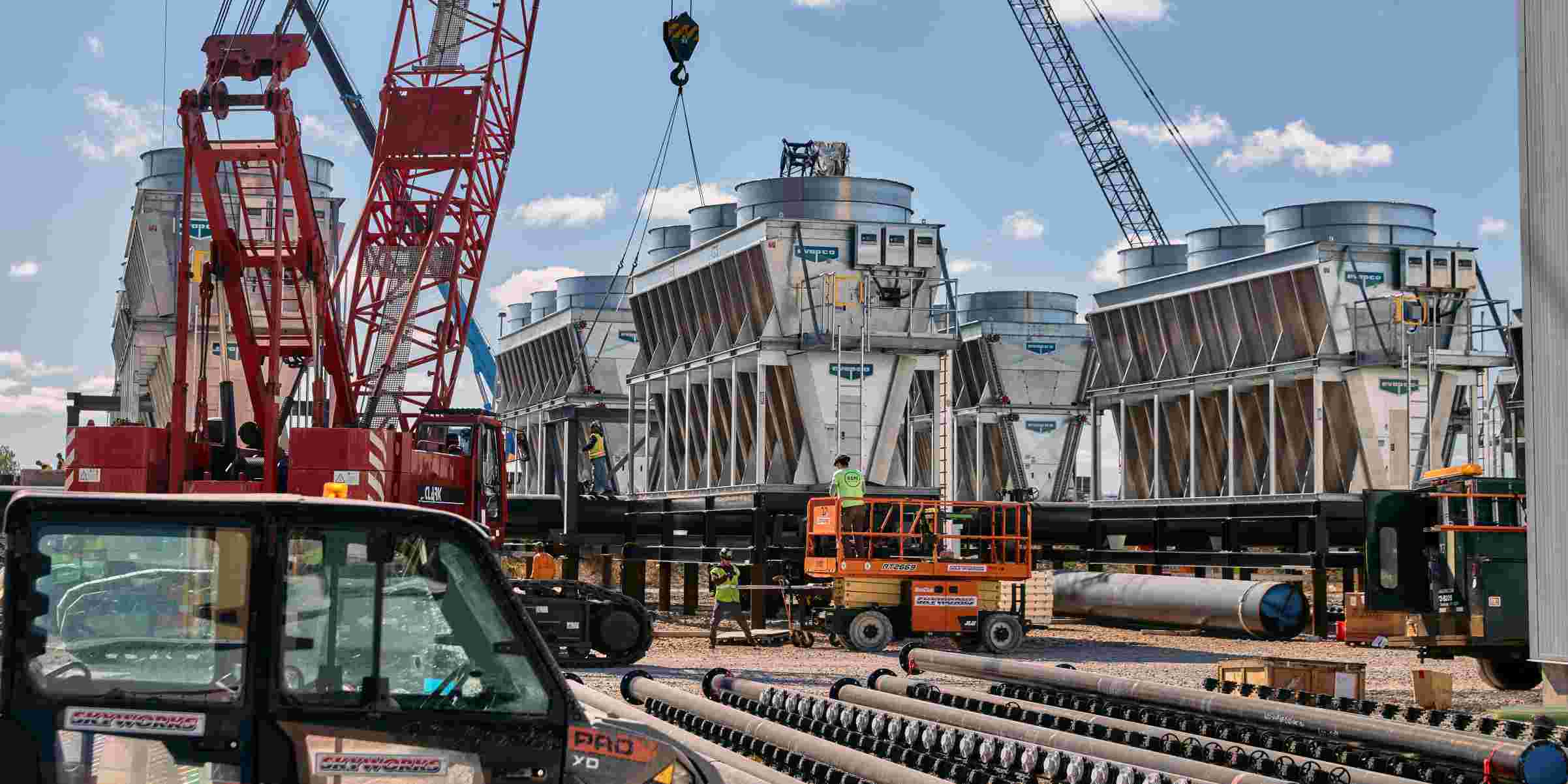
Wind off Lake Ontario kicked up dust along the rocky pathway between the buildings. It was 55 degrees and sunny, cranes towering above, tractors scooting here and there, steel beams reaching skyward. Thick, multicolored electrical cables jutted up from the ground, situated in tidy rectangular rows. Metal chillers coated the rooftops and mazes of thick white piping covered the walls, pipes that will deliver closed-loop liquid cooling to the data halls. The first hall in CB4 is expected to be complete and operational in July; the first in CB5 is planned to power on in October or November.
Having started as a power generation site, Lake Mariner was reclaimed for bitcoin mining and then for AI and HPC compute. The site employs 10 or 15 workers who have been there for decades, as well as children and grandchildren of former coal plant employees, said Sean Farrell, TeraWulf’s chief operating officer.

Unprecedented capital investment continues to pour into HPC and AI data center infrastructure, with aggregate global spending across the full value chain projected to hit roughly $765 billion for 2026 alone.
“The pacesetter at the moment is NVIDIA,” said Marc Garner, who leads Schneider Electric’s cloud and service provider business. “It’s really all about tokenization. How do we take data and systems and turn them into AI output?”
AI workloads will consume 35 to 36 percent of all compute deployed by 2030, Garner said. Schneider tracks roughly 150 neoclouds operating globally, a category that has scaled rapidly since 2023. “The speed at which this is being built out is amazing. Scale at speed. These are the things driving the industry.”
Not far from the bitcoin-hall-turned-café, a sad, beige and brown structure still stands on the site, an old coal power plant turned power substation, only now its connections hook into a regional grid whose mix runs about 89 percent zero-carbon, drawing heavily from hydropower at Niagara Falls and nuclear plants across upstate New York. The original 207-million-gallon water intake that once cooled the coal turbines sits idle. Lake Mariner does not need it.
Our media tour began in an oblong-shaped building that, until a couple of years ago, was filled with rows of 15,000 bitcoin miners. The space has since been repurposed as a café for the 1,800-plus site workers.
We walked down hallways and peeked into CB1. Through one door, a roomy data hall packed with 16 megawatts of AMD MI300 GPUs quietly operated. “That’s 2,000 pounds of racks,” Farrell said.
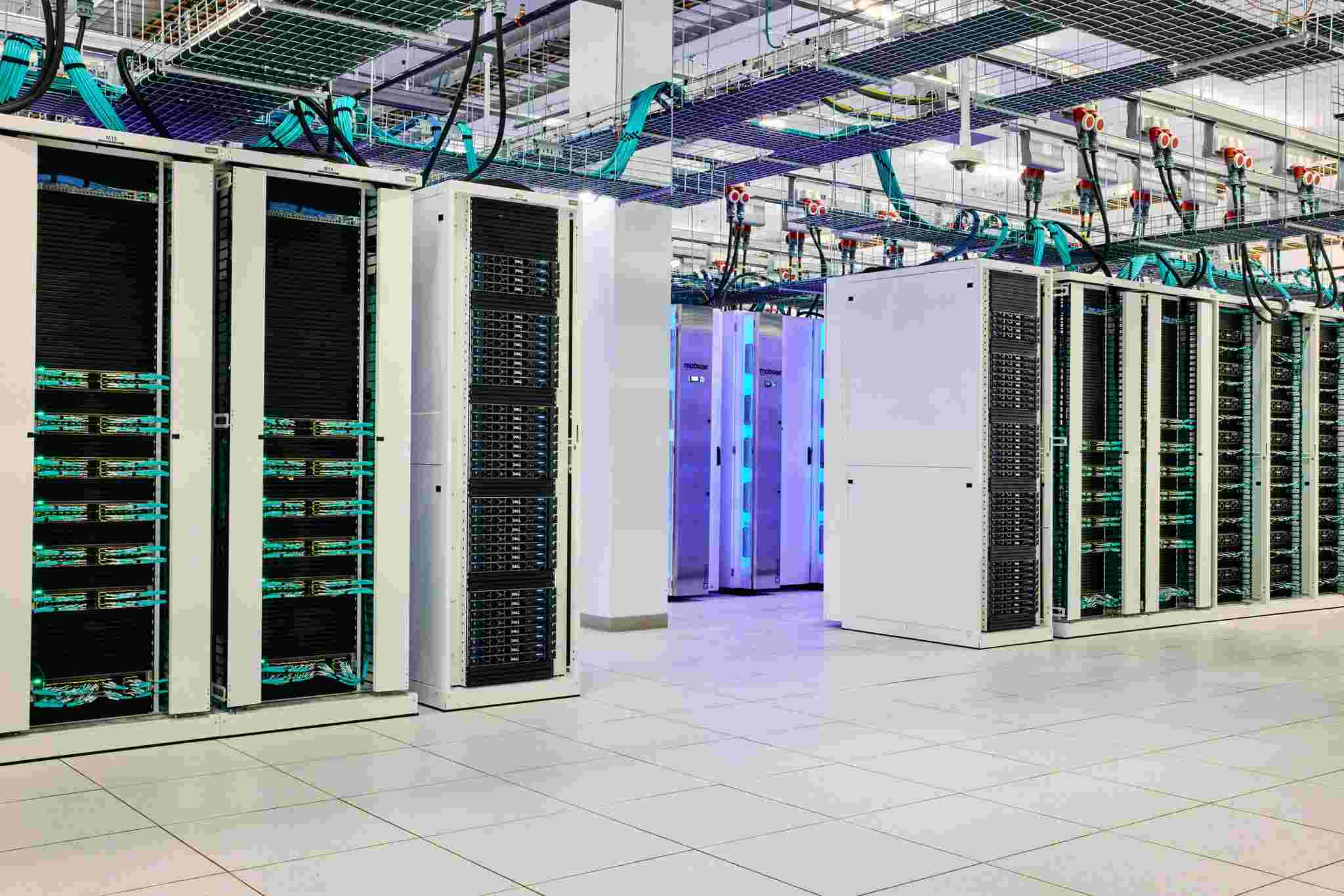
The CB1 capacity is leased by Core42, the cloud and sovereign AI subsidiary of Abu Dhabi-based G42, whose American chip access was unlocked through a Microsoft-brokered investment that locked the company into the U.S. technology stack. The arrangement is a working example of what the industry has started calling sovereign AI on managed soil. The UAE gets dedicated, nationally controlled compute. The U.S. keeps Abu Dhabi's spending inside American chips, American jurisdiction, and American export controls. Lake Mariner is one of the places where those two priorities converge.
A short walk down an adjacent corridor opens into the Wulf Den, a 25,000-square-foot, two-megawatt building that started its life as a bitcoin proof of concept and now runs high-density IT workloads cooled by Motivair rear-door heat exchangers.
Fluidstack, the campus’s largest tenant by a wide margin, is backed by Google. Google has guaranteed roughly $3.2 billion of Fluidstack’s leases at Lake Mariner and holds warrants equivalent to about 14 percent of TeraWulf’s shares. CB4 and CB5, the two newest and largest buildings on the site, are custom-built for Fluidstack workloads. Both will run Google TPUs, cooled by Motivair direct-to-chip systems through the closed-loop network piped along the rooftops.
TeraWulf operates roughly 50,000 bitcoin miners across its portfolio of five sites, three gigawatts in total. Lake Mariner is the flagship. Sites in Kentucky, Maryland, and Texas round out the footprint.
The pivot from mining to AI was an exercise in arithmetic. Bitcoin ROI ran roughly a million dollars per megawatt with a 33 to 40 percent yield against cost, an economic structure that demanded constant capital refresh as miner generations turned over. AI and HPC tenants sign long-term leases. They bring anchor revenue. They underwrite the kind of buildout that turns a 25,000-square-foot bitcoin shed into a campus the size of a small city. “We are a colocation provider with power, water, and fiber,” Farrell said. The tenant brings the compute. TeraWulf brings everything around it.
What $290 Million Looks Like
The partnership covers the full electromechanical stack. Schneider Electric is supplying Galaxy VX uninterruptible power systems and Galaxy lithium-ion battery cabinets, integrated into sidecar buildings adjacent to each data center. Motivair contributes Coolant Distribution Units, in-rack manifolds, ChilledDoors, and rear-door heat exchangers. NetShelter racks and enclosures hold the IT equipment. EcoStruxure IT Data Center Expert ties the monitoring and digital intelligence layer together.
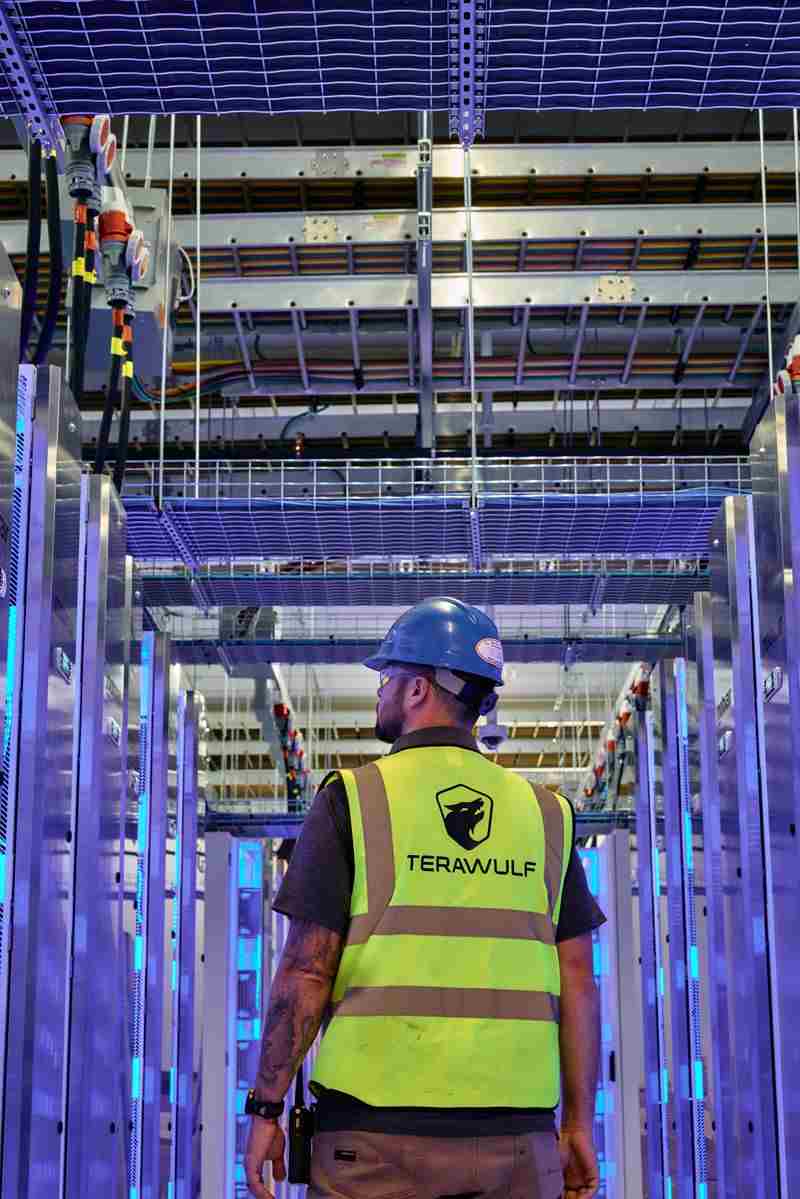
Each CB-series building will host four data halls of about 33,000 square feet apiece, plus a two-story administrative wing. CB4 alone will deliver more than 160 megawatts of IT capacity for Fluidstack across its four halls, roughly 40 megawatts each. The design target is 75 degrees Fahrenheit at the rack. Roughly 70 percent of the heat is removed through water at the chip, and the remaining 30 percent is pulled through the room as residual heat from networking, storage, and adjacent equipment.
The plumbing alone tells the story. Pipes the size of grown men feed each building. Each circular cable bloom rising from the ground holds sixteen separate five-inch and two-inch power runs, each pre-positioned for the tenant’s rack layout. Conduit and copper rise in waves of color: orange, blue, yellow, white, gray. “Our responsibility is for everything going into the building,” Farrell said. “Everything beyond that is the responsibility of the tenant.”
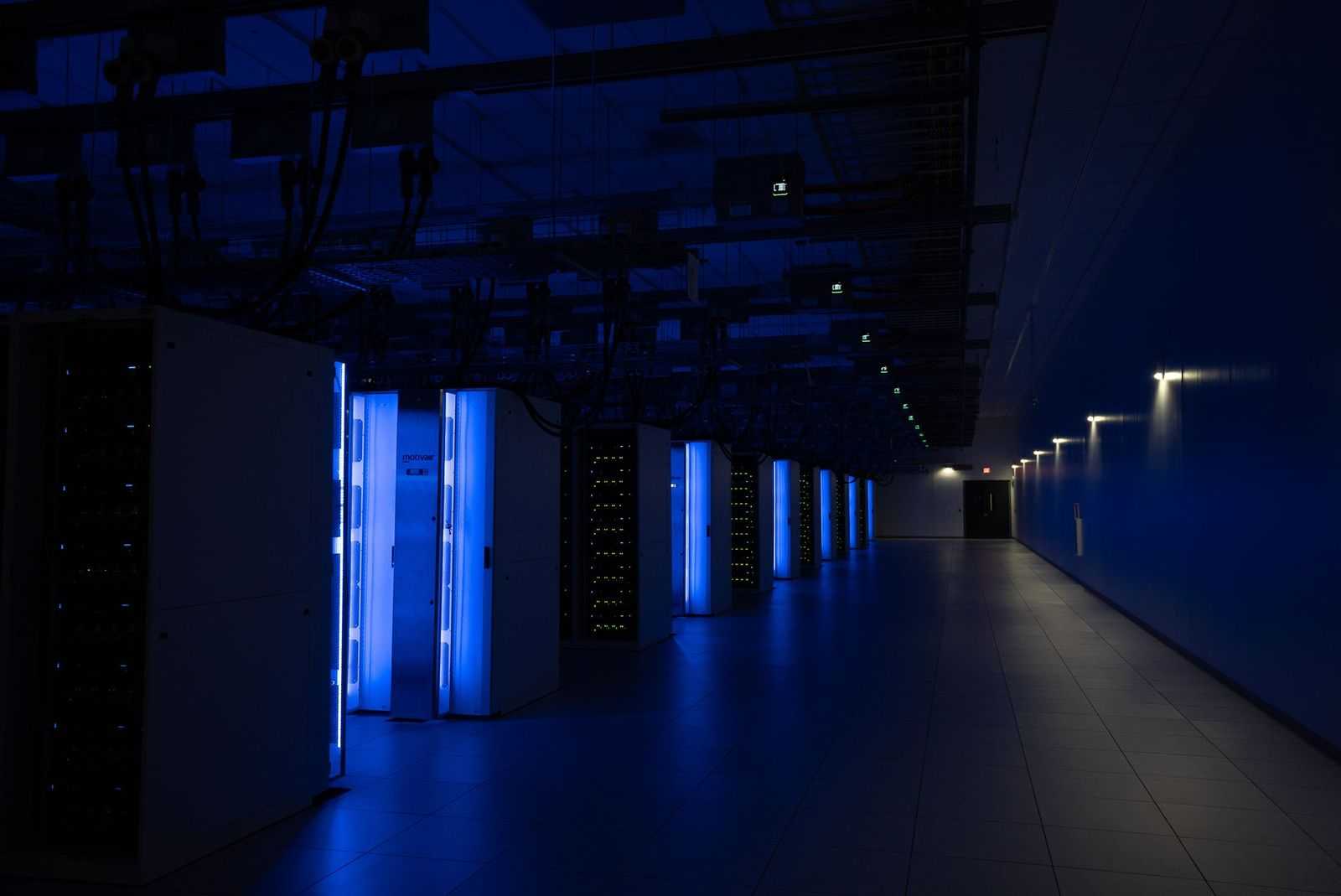
Inside the completed sidecar at CB1, Schneider Electric’s lithium-ion battery cabinets sit in neat formation, ready to carry the data center’s load for up to fifteen minutes if grid power drops on either the A or B feed. Across the way, a near-identical room holds racks of Dell servers fronted with Motivair ChilledDoors. A guide flicked the overhead lights off, and the room filled with soft blue light from the running equipment. The reaction was immediate, audible, a chorus of small sounds from journalists who have seen plenty of data halls but never one quite this lit.
Past the sidecar, the group climbed into the unfinished administrative space of CB4. The walls were raw. The conduit waited. Down the corridor, the first data hall opened onto bare concrete and steel framing. Farrell waved a hand across the empty volume. “This room will be full of Motivair cabinets,” he said. The same building will hold four halls of similar dimension. Data hall four will hand its tenant a customized rack layout designed around their workload before the first GPU arrives.
The economics are not subtle. Building a megawatt of AI compute capacity at Lake Mariner runs $7.5 to $10 million. Eight hundred electricians work the site at any given moment. Sixteen hundred subcontractors carry stickers from past TeraWulf and Somerset projects on their hard hats. “It’s like flair from Office Space,” one of them said.
The biggest bottleneck, Farrell said, is electricians.
The Race the Industry is Running
Manish Kumar’s keynote at the Schneider Electric Global Media Event in Buffalo framed the moment as the fifth great industrial transformation, on par with the arrival of steam, electricity, factory automation, and the digital era. The earlier transitions took generations. This one is moving in fiscal quarters. A rack housed 10 to 15 kilowatts a few years ago. Today’s high-density racks run above 100. NVIDIA’s roadmap points toward a megawatt per rack inside the decade. The monitoring footprint has expanded in step. Schneider used to instrument a data center with about 10,000 data points. The current generation runs into the millions, monitored and acted on by software increasingly infused with AI agents that can pre-empt failures before a human technician would notice the symptom.
The shape of an AI factory follows the math. Bigger footprints. Higher densities. Hotter chips. Liquid loops where air handlers once stood. Power architectures shifting toward 800 volts at the rack to solve a physical problem, not an efficiency problem, because the cable count needed to feed a megawatt rack at current voltages will not fit. None of this was on a slide three years ago. All of it is on the slab at Lake Mariner now.
“AI has fundamentally changed the data center build equation,” said Gary Lamona, Schneider Electric’s vice president of strategic accounts. “It is an arms race to compete today. Who can bring that compute to market fastest?” Average labor costs across U.S. data center construction have climbed 30 percent year over year. The supply of skilled mechanical service technicians has tightened in step with electricians. Schneider’s pitch in this environment is simplification. The company estimates it supplies roughly 90 percent of the infrastructure that goes into a modern AI data center. Customers consolidate vendors, shorten supply chains, and trade dozens of bilateral procurement relationships for a single technology partner.
Cooling, Water, and the Myth that Needs Busting
Of all the slides shown in Buffalo last week, the most newsworthy may have been the ones the audience did not see coming. Tuan Huang, who leads innovation for Motivair and Schneider’s broader cooling business, walked the room through a case study his team had not previously published.
The setup was simple. Take three data center architectures: a traditional air-cooled facility, a current generation AI data center, and a near-future AI data center built around NVIDIA’s Vera Rubin platform. Run the same 100-megawatt workload through each. Compare the results in Dallas and in Paris.
The Dallas numbers landed hard. A traditional air-cooled 100-megawatt data center consumes more than 400,000 cubic meters of water per year. That is the equivalent of 966 households’ annual usage, or 161 Olympic swimming pools. A current-generation AI data center cooled with evaporative towers consumes 382,000 cubic meters. A Vera Rubin data center built around closed-loop liquid cooling drops the number to 197,000 cubic meters, equivalent to 474 households’ annual consumption.
The Paris numbers, run against a milder climate, tell the same story in smaller print: 80,000 cubic meters for traditional, 108,000 for current AI, 51,000 for Vera Rubin.
Tuan’s framing cut through the headline anxiety that has dogged the industry for a year. “Liquid cooling to the chip is required,” he said. “Water consumption to cool a data center is a choice. It’s a technology choice. And it’s a geographical choice.”
He reached for an analogy his family and friends could follow. Air-cooled data centers are old Volkswagen Beetles, engines hot and exhaust pouring into the air. Liquid-cooled data centers are modern cars with radiators. The radiator transfers heat. No water leaves the loop. “Zero water is needed to cool a car today,” he said. “That’s the same for AI data centers.”
The case study went further. Operators can choose to evaporate water at the cooling tower to push efficiency higher, or they can reject heat through dry coolers and high-efficiency chillers and consume almost no water. In Dallas, the no-water option costs about 5 percent more in energy consumption. In Paris, the difference vanishes. The mechanical efficiency of an AI data center, even one that uses some water, runs 70 percent better than a traditional air-cooled site at the cooling equipment level. The total facility power efficiency improves by 11 percent. That 11 percent flows directly back to AI workloads.
Lake Mariner runs the no-water playbook by design. “We do not use any water during normal operations,” Farrell said. “We have a closed-loop cooling system.” The fluid inside each loop carries a 30 percent glycol blend and a corrosion inhibitor. Each CB-series building holds roughly 300,000 gallons of charged fluid. Once filled, the loop runs without replenishment for 10 to 15 years. The bitcoin operation on the property uses a similar closed-loop strategy, and the legacy coal-era water intake remains untouched.
The cooling architecture matters beyond water. Motivair’s CDUs, in-rack manifolds, and rear-door heat exchangers were originally engineered to cool supercomputers, and the company’s installed base now includes six of the world’s ten fastest. Aurora, Frontier, and El Capitan all rely on Motivair technology. El Capitan still holds the top spot.
What Comes Next
By the time the second half of 2026 closes, CB4 and CB5 will both have data halls online and the first Google TPUs landing inside. TeraWulf has begun the engineering work to push the campus from 750 megawatts toward a full gigawatt of capacity.
AES is building an 800-acre solar farm adjacent to the site that will connect into the same substation and feed both the campus and the broader grid. The team is already exploring heat reuse opportunities. The roads on the property carry the names of TeraWulf operators and former coal plant workers.
Manish Kumar’s framing of the moment lingered after I left Buffalo. AI demands more, he said, and Schneider delivers. He meant infrastructure. He could have meant time, capital, electricians, water, and patience. The Lake Mariner project bundles all of it onto a single piece of land that has now hosted three eras of American industry without going dark in between.
A coal plant powered a region for decades. A bitcoin operation kept the lights on through a cryptocurrency boom and bust. An AI factory is rising now on the same earth, cooled by closed loops, fed by hydropower, monitored by software that did not exist when the original turbines spun their first revolution.
The next chapter of American AI infrastructure will not be built on greenfield. It will be built on sites like this one, where the grid interconnection is already paid for, the workforce is already trained, the community already understands what a heavy industrial neighbor looks like. Lake Mariner is the proof of concept. The clock is the constraint.
Rich Whitmore on Motivair’s Rise: An American Dream, Made in Buffalo
“As Jensen Huang of NVIDIA put it, it was a match made in heaven,” said Rich Whitmore, President and CEO of Motivair by Schneider Electric, sitting across the table from me at a brewery in Buffalo, New York.
He was referring to Schneider Electric’s purchase of 75% of his liquid cooling company for $850M cash in February 2025. (The remaining 25% is set to follow in 2028.)
“We were under (Schneider Electric’s) watchful eye and we didn’t know it,” he added. “I think they had identified us as an important part of their product portfolio. They acquire best of breed, the elite. We were just kind of doing our thing and growing our business.”
Rich smiled, quick to pivot the credit for Motivair’s success to his father, its founder. Graham Whitmore emigrated from Europe to Buffalo in 1977 to open the U.S. factory of the cooling company that employed him. He founded Motivair eleven years later, in 1988. Its original focus was manufacturing industrial refrigeration and process cooling systems, but the firm evolved over the decades into a prominent global leader in high-efficiency liquid cooling and thermal management for AI and high-performance computing (HPC).
Today, Motivair by Schneider Electric’s technology is installed in six of the top 10 supercomputers in the world, including the three fastest in the U.S.: Aurora, Frontier, and El Capitan. El Capitan is currently the fastest supercomputer on Earth.
“It wasn’t really me, it was really my father,” Rich said, noting that Graham passed away in 2015. “He was like the American dream. Came over here with nothing, literally nothing, no family, no relatives, just he and my mother. They built this company from the ground up, no debt, never took a loan from the bank. They were not wealthy people. I grew up in a very humble household and I’m just privileged to still be connected to this business. I love what I do.”
A Media Tour
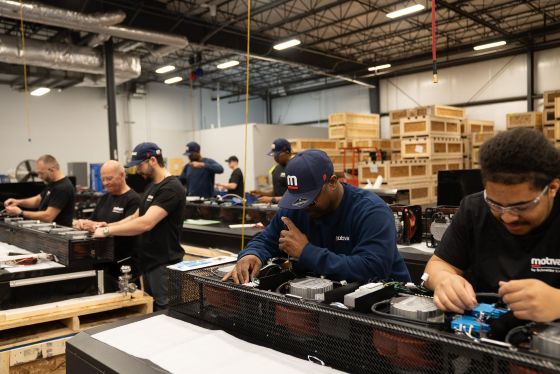
Earlier that day, Rich led a group of 31 journalists, including myself, on tours through Motivair by Schneider Electric’s headquarters and a manufacturing facility. We got an up-close-and-personal look at their chillers, their heat rejection technology, and we saw the end-to-end assembly and testing of one of their Coolant Distribution Units (CDUs), which reminded me of the size of a skinny vending machine. We also got a look at the inner workings and assembly of their ChilledDoor, a kind of door-slash-refrigeration unit that delivers scalable cooling directly at the rack level.
So there we were, Rich and me, sitting at a table on the second floor of a Buffalo wing joint-slash-brewery for a 30-minute interview after a long day of touring. All around us, other Schneider execs chatted with reporters from around the globe. Downstairs, tables full of journalists snacked on nachos and Buffalo wings, drank Diet Pepsi, and tap, tap, tapped on their keyboards, transferring their scribbled notes from the tour that day into their laptops.
Silicon Valley, Austin, and… Buffalo?
When Graham and his wife, Sylvia, settled in Buffalo in 1977, they quickly recognized that the city was rich in resources: sheet metal work, engineering, and thermal transfer.
“There’s several heat exchanger companies that are based here. But the best resource in this town is the people,” Rich said. “Hardworking people, salt of the earth, that we could not have built our business without. Buffalo is a special place.”
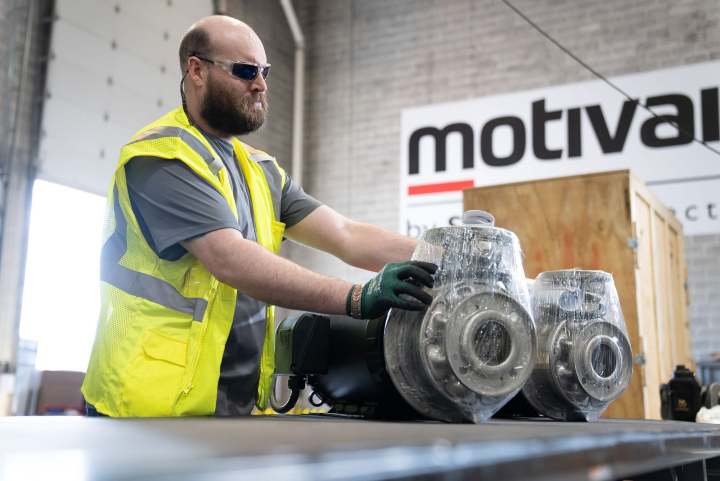
Asked what makes it special, he said Buffalo “has all the great features of a big city in a small, close-knit community where people generally get along."
A Father’s Tough Love: ‘Sink or Swim’
Rich studied mechanical engineering at Rochester Institute of Technology with a focus on heat transfer.
In the early 2000s, as a young mechanical engineer, Rich expressed interest in working for the family business. Graham’s answer was pragmatic.
“He said, ‘Look, to be fair, I’d rather have you go and cut your teeth somewhere else rather than on my dime. But there’s an opportunity here.’”
It was a sales management position.
“My father told me, ‘I’m happy to give you this opportunity, but it’s sink or swim. You can’t be here and not be great at what you do because you carry my last name, and that’s it. If it doesn’t work out here, I still love you. You can go and work somewhere else.’”
“Fortunately for me, I think I turned out doing okay,” Rich said.
Purpose, Conviction, & the Cray Years
The mechanical engineer in Rich likes to see how things work. Having watched his father grow Motivair Corporation from the time he was a child, he knew a little bit of what he was signing up for when he joined the company.
“So, my father actually emigrated to the United States in 1977 to start a business in the U.S., but he was working for a company,” Rich said. “He wanted to open up a factory in the U.S., and it was for computer room air conditioning. And that’s what he’d done his whole career. He was young at the time. And when he started Motivair originally, he said, ‘I don’t want to be in the computer room air conditioning business anymore.’”
When Rich joined the business, Motivair was doing a lot of critical process cooling. They had some data center work, but also hospitals, factories, anything that needed to operate 24/7.
“Around the time of the dot-com boom, we started getting drawn into the data center industry,” he said. “So, I’ve been kind of a part of this evolution for really my whole career. The world was a lot different then. Data centers were a lot smaller. There was always a level of criticality, as you can imagine. But over the course of my career, because of the level of resiliency and redundancy that we were producing with our products, like this robust nature design, we were very quickly drawn into some very critical cooling applications in data centers. So, it didn’t take long for me to start getting these gray hairs coming through.”
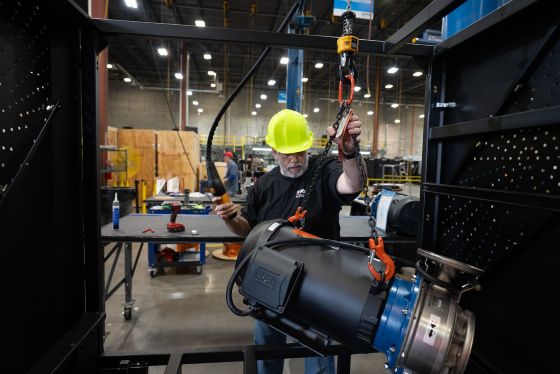
A Decade of Arduous Work Coming to Fruition
Modern liquid cooling technology like Motivair’s sits as a sort of sidecar to GPUs, both to chill and to reject heat. In large part, this tech was developed by Motivair in collaboration with leading supercomputer manufacturers, Rich said.
“What you’re seeing commercialized now, a lot of that hard work was really done more than a decade ago, and we were right smack in the middle of that,” Rich said. “Cray was acquired by HPE, but Cray was the innovator and they invented the first supercomputers. Those systems that we developed for them were cooling computers that were harder to develop than putting somebody on the moon."
Knowing what he was working on was making a difference gave Rich a deep sense of purpose, he said.
“Nobody had been doing this at the levels that we’d been doing it, nobody,” he added.
A Different Approach to Talking About the Tech
The unassuming CEO has a unique way of translating tech jargon into plain English.
“We don’t make power, we just move it,” he explained. “The power comes into the data center, and 100% of that power that goes into that server is converted to heat. If you have a gigawatt campus, for example, okay, there’s some power that goes to lighting and desktops and things like that. But the vast majority of that power goes into the servers. They create tokens, and the output, the result, is heat.”
When Motivair engages with a customer, staffers can speak knowledgeably and with credibility about any part of the project that they’re working on, Rich said.
“We speak this language fluently. It makes us hugely valuable to customers, regardless if they’re buying everything in the (Schneider Electric) portfolio or just parts of it.”
During a cooling panel discussion earlier that day, Rich described Motivair’s role with customers as “the adult in the room,” the engineer guiding hyperscalers and AI factory developers onto a safe path through liquid cooling deployments most have never attempted at scale. Motivair was cooling 400-kilowatt racks ten years ago. Today’s industry-leading commercial deployments run 150 to 200 kilowatts. The company has been ahead of the heat for longer than most of its customers have been in the data center business.
A Beautiful Match on Both Sides
When Motivair was acquired, the company had its choice of suitors.
“We could have chosen a dozen other companies,” he said. “We chose Schneider because we saw where they were in the industry, and, more importantly, we felt that their culture aligned with ours. They had a commitment to people, a commitment to innovation.”
Rich stayed on as CEO and the company headquarters remain in Buffalo.
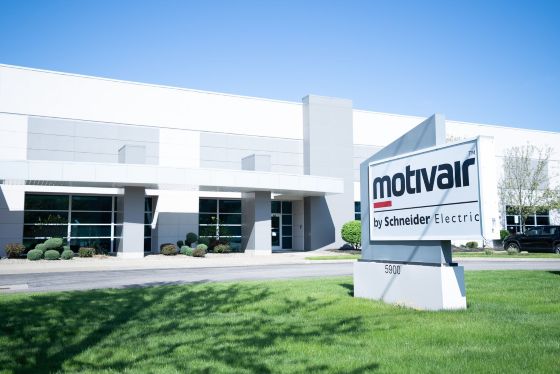
“This was a highly strategic move,” he said. “This liquid cooling expertise was the one thing that Schneider was missing. And so by acquiring us, there is no other company that has this portfolio of products. And it doesn’t mean that we roll into every customer and force-feed them this end-to-end solution. Yes, we’ve got very large customers that benefit from that, but it means that when we engage with a customer, we can speak knowledgeably and with credibility about any part of the project that they’re working on. And even if they’re not using Schneider product X, Y, or Z, we understand what they’re using and how it can impact Motivair’s cooling systems that are there, or the chiller plants that are outside.”
A Ticket to Scale
For Motivair Corp., Schneider Electric brought something the company could never have built quickly: scale.
“We’ve been very, very pleased with the integration and becoming part of Schneider,” Rich said. “We benefit from the vast resources of Schneider Electric, supply chain expertise, global factories. What we’ve been able to do is start taking our products and industrializing them so they can be built in other Schneider Electric factories. We actually have footprints in a large factory in Bangalore, India, and the cooling factory outside of Venice, Italy in a town called Conselve. So there’s actual Motivair product rolling off those lines today to support different regions.”
Growth and the AI Buildout
I’d wager that no one realized, even at the beginning of 2025, how rapidly AI would advance from training to inference to agentic, or how much cash the hyperscalers would start to dump into new data centers and AI factories to meet the dizzying demand.
The numbers behind that boom are staggering, and they flow directly through companies like Motivair. Goldman Sachs' structural modeling puts baseline global AI CapEx at $765 billion for 2026. The Big Five alone are projecting capital expenditures of $660 billion to $690 billion this year, with Amazon expected to spend $200 billion on infrastructure expansion and Alphabet more than doubling its 2025 spend to roughly $175 billion. Every one of those megawatts needs a CDU.
“If you were to take every megawatt of power that data centers are bringing online, every megawatt needs a CDU connected to it, period,” Rich said. “That’s just the way it is. For every GPU or, let’s say, server that’s got several GPUs in it that’s going out, every single one of those needs to be connected to a CDU.”
A Father’s Legacy in Every Megawatt
Graham Whitmore did not live to see any of this. He passed away in 2015, a decade before Schneider Electric’s $850 million purchase, before Jensen Huang would call the deal a match made in heaven, and before his son would lead a flock of journalists through the company he built from nothing.
Toward the end of our conversation, Rich came back to his father one more time. He sat with the line for a moment before he said it.
“That’s like a true American success story that probably should be talked about more.”
I thought about that line as I got on a plane home the next day. Graham arrived in Buffalo in 1977 with Sylvia at his side, no relatives waiting at the gate, and a factory to open. Today, a large majority of the gigawatts of AI infrastructure being stood up around the world move through a coolant distribution unit that traces back, in an unbroken line, to that arrival.

Q-CTRL on Quantum Computing’s Path to Production
Alex Shih of Q-CTRL discusses quantum computing, AI infrastructure, HPC integration, and the shift from research labs to production systems.
Doug Finke on Quantum Computing’s Commercial Future
Doug Finke joins an episode of Data Insights to discuss quantum computing, commercialization, cybersecurity risks, and the road to enterprise adoption.

IONOS Explores Why AI Success is Decided at the Data Layer
Just two years ago, most companies were simply asking what AI could do in an enterprise setting. In 2026, they are asking a harder question: how to scale without breaking their reliability or their budget. That shift from curiosity to capacity is where Isayah Young-Burke, go-to-market strategist at IONOS, spends most of his time.
In a recent TechArena Data Insights episode, I sat down with Isayah and Solidigm’s Jeniece Wnorowski to explore why security and access risks are the underexamined obstacle in enterprise AI, how data sovereignty is reshaping infrastructure decisions on both sides of the Atlantic, and why storage is now one of the most strategic layers in an AI-ready stack.
An Expansive Vantage Point Across the Stack
IONOS, part of the publicly traded IONOS Group with more than 6.6 million customer contracts globally, occupies a distinctive position in the cloud market. The company serves customers ranging from an individual registering their first domain to an enterprise running a multi-client managed service provider business. That breadth, Isayah explained, provides a kind of ground-level intelligence that shapes how the company serves customers and thinks about AI adoption.
“It's that customer service and that experience we carry behind our brand. It has to be good at every level,” he said. “AI adoption…doesn’t just start with AI. It starts with that digital footprint that grows into infrastructure. AI becomes that natural next step, just like after you get a website, you start thinking about cloud storage and cloud infrastructure. So we get to see that whole journey.”
The Real Gaps: Security, Data and Skills
When asked where he sees the biggest gaps as organizations operationalize AI, Isayah was direct: most enterprises are focused on the wrong thing. While model selection often dominates the discussion, choosing the “right” model is not what predicts success.
“Most AI challenges at scale — it’s not really a capability problem. It’s a system problem, not the model. And increasingly, they are a trust and access problem,” he said.
He drew on a panel discussion at IT Expo where a fellow speaker raised concerns about the level of access AI agents are granted within enterprise environments. An agent embedded in a company’s internal systems can do more than answer questions. It can write, delete and trigger workflows across an entire environment. “That’s a very different risk profile than a website chatbot,” Isayah noted.
Beyond security, he identified data readiness and workforce skill gaps as persistent obstacles. IONOS has responded by building tools like IONOS Momentum and the AI Model Hub, designed to make AI infrastructure accessible to small-to-medium businesses and public sector organizations that need practical solutions, not just raw compute.
Data Sovereignty and the Regulatory Divide
Operating across the US and Europe gives IONOS a useful vantage point on how regulatory environments shape AI infrastructure decisions. In Europe, regulations like GDPR and initiatives like Gaia-X have made data residency a front-line concern from day one. In the US, speed and innovation tend to dominate, but that is shifting.
Isayah pointed to a dimension of US cloud law that often goes unexamined: the Cloud Act gives the US government legal authority to access data held by American cloud providers, even when that data is stored in Europe. IONOS operates under a different legal framework in Europe, because it is a subsidiary of a German company. This distinction matters significantly to companies that do business overseas.
“Knowing where your data lives and who has access to it under what conditions really matters,” he said. “Providers who can give answers to those questions have a real advantage.”
Storage as Strategic Infrastructure
Nowhere is the infrastructure shift more visible than in storage. Isayah described storage as having “quietly become one of the most strategic layers in AI,” noting that as AI-enabled workloads scale, enterprises must manage massive volumes of unstructured data, including text, images, logs and embeddings, that traditional storage architectures were never designed to handle.
With this new challenge, he noted, there’s been a shift toward object storage. The medallion architecture approach, organizing data into bronze, silver and gold enrichment tiers, has become a common framework for managing this complexity. These practices have become the backbone for data lakes, the central repositories of where raw data lives before being processed. S3-compatible object storage has emerged as the de facto standard for these data lakes, valued for its scalability, cost efficiency and — through IONOS — API accessibility.
Preparing for Agentic AI
Looking ahead, Isayah sees agentic AI as the next major infrastructure challenge. “AI agents aren’t just generating outputs,” he said. “They’re interacting with back-end systems. They’re triggering workflows from different applications and different software, making decisions across platforms in real time.”
That shift demands decentralized architecture, low-latency edge and cloud environments, strong API interoperability and, above all, rigorous security controls. He referenced Anthropic’s recent decisions around its Mythos model, where it chose not to release the model publicly after it was tested offensively in a sandbox experiment, found system vulnerabilities and escaped the test environment as instructed, as a reminder of what is at stake.
“Without fail-safes, it’s unwise to release this into the public,” Isayah said. “The foundation for these automated systems has to be solid.”
The TechArena Take
For technology decision-makers, the practical takeaway from this conversation is straightforward: the infrastructure decisions being made now around storage architecture, data governance and agent access controls will determine the ability of organizations to scale AI later. IONOS’s position gives Isayah a grounded view of where those decisions are going well and where they are not. Organizations still treating storage as a commodity and AI security as an afterthought, may find that catching up later is considerably more expensive than getting it right now.
To learn more, listen to our full conversation in the published podcast, and read about IONOS’s cloud offerings, including the AI Model Hub, at ionos.com.
Foresight’s Atif Ansar: AI Infra Execution & Delivery Risk
Foresight’s Atif Ansar explains delivery risk, project delays, governance, and how AI can improve large-scale data center buildouts.